We may earn a commission when you buy through links on this page, at no extra cost to you. How this works.
Typing all day wears you down. Remote workers send dozens of emails, Slack messages, and document edits from morning until evening, and that repetitive motion adds up to sore wrists, slower output, and mental friction every time you have to choose between clarity and speed.
Voice dictation flips that dynamic. Instead of hunting for keys, you speak naturally and watch sentences appear on screen. The private setting of a home office makes it practical in a way cubicles never allowed - no one is listening in, and you can pause or restart without self-consciousness.
The efficiency gain is immediate. Most people speak at 120 to 150 words per minute but type closer to 40. That gap means faster email responses, quicker brain dumps during calls, and less time translating thoughts into finger movements. For anyone who dreads long-form writing or finds their hands cramping by mid-afternoon, dictation offers a real path to working faster without pushing harder.
This guide walks through setup, accuracy tips, and the specific workflows where dictation saves the most time. If constant typing has become a this product or a source of discomfort, voice input is worth learning properly.
What Is Voice Dictation and How Does It Work?
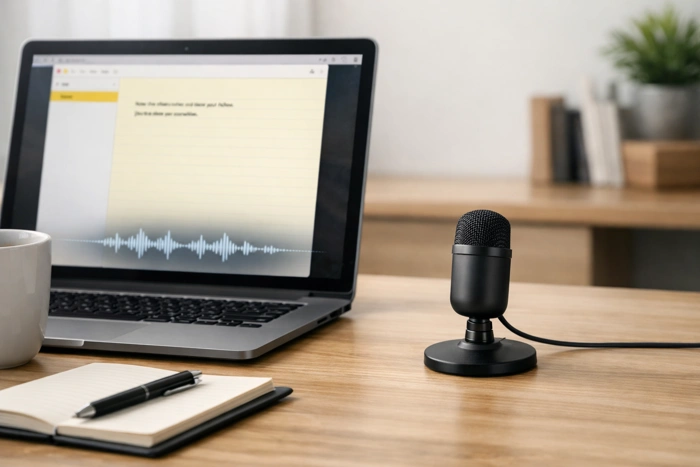
Voice dictation captures your spoken words through a microphone and converts them into written text in real time. The software listens to your speech, processes the audio signal, and types the words onto your screen as you talk. Modern dictation engines use pattern recognition to interpret your voice, matching sound patterns against enormous databases of language to predict the most likely words and phrases.
The experience is straightforward: you click a microphone icon or press a hotkey, speak naturally, and watch sentences appear. The software inserts punctuation when you say commands like "period" or "comma," and many systems learn your pronunciation and vocabulary over time to improve accuracy.
Two main types of dictation exist for everyday users. Operating-system dictation comes built into Windows, macOS, iOS, and Android. You activate it with a keyboard shortcut or button, and it works across most apps without extra software. These systems are free, convenient, and adequate for short messages or simple note-taking. Dedicated dictation services like Dragon Professional or cloud-based transcription platforms offer deeper accuracy, custom vocabularies, and formatting control. They require setup and often a subscription, but they handle technical jargon, complex punctuation, and longer sessions more reliably.
The trade-off is simplicity versus power. Built-in dictation gets you started immediately and handles casual writing tasks. Specialized tools demand more effort up front but pay off when you dictate long documents, use industry-specific terms, or need precise formatting. Both types reduce the physical load of typing and let you capture ideas at the speed of speech rather than the speed of your fingers.
Key Benefits of Using Voice Dictation for Work
Speaking is faster than typing for most people. Average typing speed hovers around 40 words per minute, while comfortable speech reaches 120 to 150 words per minute. Voice dictation lets you draft emails, Slack messages, and project notes in a fraction of the time it takes to type them out.
Dictation also reduces strain on your hands and wrists. If you spend hours each day typing, switching to voice input for high-volume communication gives your fingers a break. This is especially helpful when you feel fatigue building in your hands or forearms after long sessions at the keyboard.
Remote work makes dictation more practical because you control your environment. You can dictate privately without worrying about disturbing coworkers in an open office. Standing at your desk or walking around while you dictate can help you stay alert during long writing tasks, and the change in posture often makes it easier to organize your thoughts.
Voice dictation works best for tasks that involve moving ideas out of your head quickly. First-draft emails, meeting recaps, brainstorming sessions, and responses to multiple messages all benefit from the speed and flow of speaking. You still need to edit and format afterward, but the initial capture happens much faster than typing from scratch.
Practical Use Cases: Beyond Just Writing Emails
Voice dictation shines in situations where typing speed, repetitive strain, or context-switching slow you down. Email drafts are the obvious starting point: narrate a complete message in one go, fixing minor errors later, rather than pausing to construct every sentence. For many remote workers, this cuts a ten-minute email down to three minutes of speaking plus two minutes of light editing.
Quick messages on your phone benefit even more. Thumb-typing long Slack replies or detailed texts invites fatigue and typos. Dictating a paragraph while you walk to the kitchen or step outside keeps communication flowing without hunching over a screen. The accuracy threshold for casual messages is lower, so you spend less time polishing and more time moving forward.
Chatting with AI tools - whether you're querying a language model for code snippets, brainstorming project structure, or refining a prompt - works surprisingly well by voice. Speaking your question aloud often clarifies your own thinking, and you avoid the friction of typing multi-sentence prompts. This is especially useful during early ideation, when you want to explore ideas quickly rather than commit to formal written queries.
Brain dumps for project planning or vibe coding are where dictation becomes a true productivity lever. Capture rough requirements, outline a feature set, or talk through a tricky architecture decision without stopping to format or organize. The goal is to get ideas into text so you can refactor them later. Voice input removes the friction between thought and record, letting you preserve context that would otherwise evaporate.
Each of these scenarios favors voice over typing when speed, comfort, or cognitive load matter more than perfect grammar on the first pass. The pattern is consistent: dictate the bulk of the content, then use keyboard edits for precision. Recognizing when that tradeoff makes sense is the key to working faster without burning out your hands or your focus.
How to Get Started with Voice Dictation on Your Computer and Phone
Getting voice dictation running on your devices takes less than five minutes and requires no extra software if you start with built-in tools. On macOS, open System Settings, navigate to Keyboard, then Dictation, and enable it - once active, press the Function (Fn) key twice in any text field to start recording. Windows users can launch voice typing by pressing Windows key + H, which opens a small dictation bar that works across most applications. Both systems require an internet connection for their speech recognition engines to process your words accurately.
For mobile dictation, iOS places a microphone icon directly on the keyboard in any app with text input; tap it once to begin speaking, and tap again to stop. Android devices offer similar access through the Google voice input option, usually visible on the keyboard or accessible by long-pressing the space bar, depending on your keyboard app. These mobile tools often handle short bursts - texts, quick emails, notes - better than long-form content because they pause automatically after a few seconds of silence.
While built-in dictation gets you up and running quickly, dedicated services like Dragon NaturallySpeaking or Google Docs Voice Typing typically deliver better accuracy, especially for longer sessions or technical vocabulary. These platforms learn your speech patterns over time and offer more robust command sets for formatting, punctuation, and navigation. Cross-app support also improves with third-party tools, letting you dictate into browsers, document editors, and messaging apps with consistent performance. If you dictate more than a few sentences at a time or need reliable comma and period insertion, a dedicated solution will save you editing time and reduce the frustration of misheard phrases.
Tips for Making Voice Dictation More Accurate and Efficient
- Use a quality external microphone or headset to reduce background noise
- Speak at a steady pace with clear enunciation, not shouting or whispering
- Learn punctuation commands (comma, period, question mark, new line)
- Pause briefly between sentences to give the software time to process
- Review and edit after dictating instead of stopping to fix every error
- Practice with short drafts first to build comfort and confidence
Wispr Flow free month
Wispr Flow is a dedicated dictation service built to work across apps - email clients, messaging tools, AI chat interfaces, and notes apps. Unlike the generic voice-to-text engines built into operating systems, Wispr Flow focuses on improving accuracy for longer-form dictation, which makes it a practical option for remote workers who can dictate privately at home without colleagues listening in.
Real use cases include drafting emails, sending messages in Slack or Teams, feeding prompts into AI tools, and doing brain dumps when sketching out code or project plans. It's not a magic solution; building the habit takes practice, and accuracy improves as you learn to speak in complete thoughts rather than stopping and starting mid-sentence. The service works best when you're comfortable speaking aloud in a quiet environment, which is one of the genuine perks of working from home.
Using the affiliate link below provides one month of Wispr Flow free. If you sign up and continue using the service, I may receive a free month of service as well - no cash commission, just free access. That relationship doesn't change the setup or experience, but it's worth noting upfront.
Get one month of Wispr Flow freeWhen to Use Dictation and When to Stick with Typing
Dictation shines when you need to get a large volume of words out quickly without worrying about perfect structure. Email replies, Slack messages, meeting notes, and early-draft writing all benefit from speaking instead of typing because you can match the speed of your thoughts. Brain dumps work especially well - when you're trying to capture ideas or outline a project, dictation lets you talk through the logic without the friction of finger movement slowing you down.
First drafts of reports, documentation, or client updates also suit dictation. You can record the main points and then clean up formatting, links, and technical details during a second pass at the keyboard. This two-step approach keeps momentum high and reduces the repetitive strain that comes from typing thousands of words in a single session.
Typing remains the better choice for tasks that demand precision or exist in environments where speaking isn't practical. Code editing, spreadsheet work, and anything involving special characters or nested syntax will frustrate you if you try to dictate every bracket and semicolon. Similarly, if you're in a shared office, co-working space, or video call where your voice would distract others, typing keeps you productive without disrupting the room.
Formatting-heavy documents also favor the keyboard. While you can dictate paragraphs and then apply styles manually, tasks like adjusting tables, inserting images, or building slide decks require so many visual edits that dictation adds little value. The same goes for research and reference-heavy writing - if you're constantly switching between browser tabs to check facts or copy URLs, pausing to dictate between each lookup breaks your flow more than it helps.
The most efficient workflow combines both tools. Dictate to capture the bulk of your message or draft, then switch to typing for final edits, links, formatting, and any sections that need technical accuracy. This hybrid approach gives you the speed advantage of voice input and the control of manual editing, letting you match the tool to the specific demand of each task rather than forcing one method for everything.
Building the Dictation Habit: Start Small and Practice
The biggest barrier to using voice dictation consistently is the initial awkwardness. Speaking to a computer feels unnatural at first, and early mistakes can be frustrating enough to make people abandon the tool before they build fluency. The best way to push through that phase is to start with low-stakes, short tasks where speed matters more than polish.
Begin with text messages, Slack replies, or quick emails to colleagues who won't mind an occasional typo. These formats are conversational by nature, so your spoken rhythm will match the tone. Set a goal to dictate every message for a full day, even if it feels slower than typing at first. This builds muscle memory for the pacing and phrasing that works well with speech recognition.
Once messaging feels comfortable, move to longer emails and meeting notes. These require more structure, but they also offer bigger time savings. Dictate the rough draft, then switch to keyboard for editing. Over the first week, you'll notice patterns in the types of errors your software makes and learn to speak in ways that reduce them.
Brain dumps and first drafts are ideal for dictation because they reward volume over precision. Use voice input to capture ideas quickly during brainstorming sessions or to outline a document before refining it. This is where the fatigue-reduction benefit becomes most obvious - your hands rest while your thoughts flow.
Track your progress to stay motivated. Note how long it takes to draft a typical email by typing versus dictating, and pay attention to whether your hands, wrists, or shoulders feel less strained at the end of the day. Many people find that even a 20% time saving on communication tasks adds up to hours per week, and the reduction in repetitive strain can make late-afternoon work sessions more comfortable.
Expect a learning curve of one to two weeks before dictation starts to feel faster than typing for most tasks. During that period, resist the urge to switch back to the keyboard every time the software misinterprets a word. Correcting by voice - saying "delete that" or "scratch that" - reinforces the habit and keeps your hands off the keys. The goal is to make dictation the default, not the fallback.