We may earn a commission when you buy through links on this page, at no extra cost to you. How this works.
Standard office chairs often lack adequate lower back support, leaving the natural curve of your lumbar spine unsupported during long work sessions. This gap forces you to either slump forward or overarch, both of which contribute to stiffness and discomfort by the end of the day.
A quality lumbar support pillow fills that gap with targeted cushioning that encourages a neutral sitting posture. The difference between a helpful pillow and one that simply takes up space comes down to a few measurable attributes: strap design that keeps the pillow anchored without sliding, memory foam density that provides firm support rather than collapsing under your weight, this product fabric that prevents heat buildup during extended use, and thickness that matches the depth of your chair and the curve of your back.
Budget models typically use thinner foam and simpler elastic straps, which can work well for lighter users or shorter sessions but may compress or shift during a full workday. Premium options usually offer denser foam cores, adjustable dual-strap systems, and mesh or ventilated covers that improve airflow. The tradeoff is straightforward: lower-priced pillows sacrifice longevity and adjustability, while higher-end designs add features that matter most when you sit for six hours or more.
We evaluated five memory foam lumbar pillows across this spectrum, comparing strap stability on chairs with vertical and angled backrests, measuring foam thickness and rebound after compression, assessing fabric breathability during typical office temperatures, and noting real-world price differences. Each pillow was used on a standard mesh-back task chair to identify which design choices make a practical difference and which features amount to marketing noise.
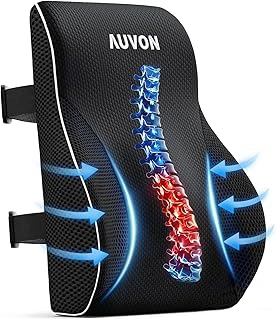
AUVON Memory Foam Lumbar Support Pillow for Office Chair
The AUVON Memory Foam Lumbar Support Pillow delivers solid lower-back cushioning for $21.99, making it one of the more affordable options that still uses full-density memory foam. With a 4.4-out-of-5 rating, it sits in the sweet spot between budget padding and premium ergonomic pillows.
The pillow attaches with adjustable elastic straps that wrap around most standard mesh and fabric office chairs. Two buckle fasteners let you dial in horizontal placement and keep the cushion from sliding during the workday. The straps stretch to fit chair backs between roughly twelve and twenty inches wide, so they work on many mid-sized task chairs. Extra-wide executive seats or very narrow stools may hit the limits of the strap range.
Memory foam thickness provides enough pushback to support the natural curve of your lower spine without feeling overstuffed. The firmness holds your lumbar region forward, which can reduce slouching when you sit for long stretches. If you prefer a softer, plush feel, this pillow leans toward the supportive side rather than the squishy side.
A AUVON Memory Foam Lumbar Support Pillow for Office Chair mesh cover wraps the foam, helping air circulate against your back. It won't eliminate heat build-up entirely on warm days, but it performs better than solid fabric shells. The cover is removable and machine-washable, so you can keep it fresh after months of daily use.
Because the pillow adds depth between your back and the chair, you may need to pull your seat closer to your desk or adjust armrest height to maintain comfortable elbow position. Test the placement during your first few sessions to find the right balance of support and reach.
The AUVON pillow works well for standard upright sitting postures. It may feel too firm if you lean back frequently or recline during calls. Pairing it with a seat cushion can level out pressure distribution across your entire sitting surface.
At just under twenty-two dollars, the AUVON offers dependable strap attachment, memory foam that holds its shape, and a washable cover - three features that matter most for daily office-chair use.
- ✅ $21.99 price point balances quality and affordability
- ✅ Adjustable elastic straps with buckles fit most standard chair backs
- ✅ Memory foam density supports lumbar curve without excess bulk
- ✅ Breathable mesh cover is removable and machine-washable
- ⚠️ Strap range may not accommodate extra-wide or very narrow chairs
- ⚠️ Firmer feel may not suit users who prefer plush cushioning
- ⚠️ Adds depth that can require desk or armrest repositioning
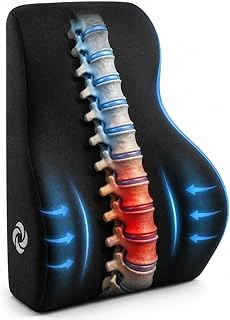
Samsonite Memory Foam Lumbar Support Pillow for Office Chair
The Samsonite Memory Foam Lumbar Support Pillow retails for $24.99 and carries a 4.3 out of 5 rating on Amazon. Its primary strength is adjustability: elastic straps with quick-release buckles let you reposition the pillow vertically along most office chair backs without tools or permanent hardware.
Strap length accommodates chair widths from narrow task chairs to wider executive models, giving it broader compatibility than fixed-loop designs. The buckle mechanism clicks firmly into place and releases with a single press, so you can shift the pillow up or down as you change tasks or seating positions during the day.
This model works especially well on chairs with straight or slightly curved backs where vertical placement matters. If you sit upright for keyboard work but lean back during calls, the quick buckle adjustment lets you find the right spot for each posture without fiddling with knots or elastic tension.
Compared to the AUVON pillow, which uses fixed dual straps, the Samsonite offers more vertical range and faster repositioning. That trade comes with slightly less lateral grip on very wide or contoured chairs, where dual anchor points can add stability.
The memory foam core is medium-firm - softer than high-density models but firm enough to maintain lumbar curve support through a standard workday. Breathability is average; the pillow uses a polyester mesh cover that allows some airflow but may feel warm during longer sessions in non-air-conditioned spaces.
At this price point, the Samsonite balances adjustability with everyday durability. The buckle system holds tension well over repeated adjustments, and the foam returns to shape after compression. If you need to fine-tune pillow height frequently or share a chair with someone who sits at a different height, the strap design delivers practical flexibility without adding bulk.
- ✅ Quick-release buckle allows fast vertical repositioning
- ✅ Elastic straps fit narrow to wide office chair backs
- ✅ Medium-firm memory foam maintains lumbar curve support
- ✅ Priced at $24.99 with solid 4.3/5 rating
- ⚠️ Less lateral stability on very wide or contoured chairs compared to dual-strap models
- ⚠️ Polyester mesh cover offers average breathability in warm environments
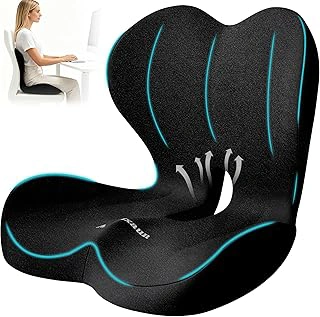
Amxixaun Memory Foam Lumbar Support Seat Cushion
Taller users and anyone who wants support extending higher up the back will find the Amxixaun Memory Foam Lumbar Support Seat Cushion covers more vertical real estate than most compact lumbar rolls. Priced at $39.99 with a 4.2 rating, this cushion spans a larger area of the backrest, which helps distribute pressure across the mid- to upper-lumbar region rather than concentrating support at a single focal point.
The memory foam construction provides cushioning that conforms gradually, and the extended height means the top edge sits higher on the chair back. This design works well if your torso is long or if you prefer contact that reaches closer to your shoulder blades. The strap system wraps around the backrest to hold the cushion in place, and adjustment is straightforward on most standard office chairs.
Keep in mind that the taller profile can create fit challenges with lower-backed task chairs, where the cushion may extend above the backrest or push against an integrated headrest. If your chair has a short back or a fixed headrest that sits low, measure the available space before purchasing. For chairs with tall, open backrests and users who need support higher than the typical lumbar curve, this cushion delivers extended coverage that smaller options cannot match.
- ✅ Extended vertical coverage for taller users
- ✅ Memory foam conforms to mid- and upper-lumbar regions
- ✅ Adjustable strap system fits most standard office chairs
- ⚠️ May extend above backrest on lower-backed task chairs
- ⚠️ Can conflict with integrated or low-mounted headrests
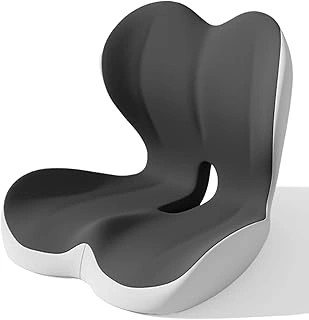
Ergonomic Memory Foam Seat and Lumbar Support Pillow
The ergonomic memory foam seat and lumbar support pillow offers a dual-cushion approach for remote workers who spend six or more hours seated. At $39.99, this combo pairs a contoured lumbar cushion with a matching seat pad, both wrapped in a mesh cover designed to promote airflow during long video calls and focus sessions.
The this product cover fabric helps reduce heat buildup across your lower back and under your thighs, a common problem with solid foam cushions in warm offices or during summer months. Memory foam in both components compresses gradually to match your posture, and the mesh layer pulls moisture away from the fabric surface. Users working in climates above multiple°F or in rooms without strong air conditioning will notice the ventilation advantage most clearly.
Because this set includes both a seat and lumbar cushion, total thickness increases compared to a lumbar-only pillow. The lumbar section measures approximately three inches at its deepest point, while the seat pad adds another two inches of lift. If your chair already sits high or your desk height is fixed, this extra elevation may push your knees above your hips or force your forearms into an awkward angle at the keyboard. Test the combined height before committing to all-day use.
Installation requires securing two separate pieces. The lumbar cushion attaches via adjustable elastic straps that loop around the chair back, and the seat pad rests on the chair base with a non-slip bottom and an optional strap that anchors under the seat. Setup takes about three minutes, but narrower task chairs with seat widths under the listed size may not accommodate the full footprint of the seat component without overhang.
The 5.0 rating reflects consistent feedback on cooling performance and the stability of the dual-cushion design. The mesh cover remains taut after repeated compression cycles, and the elastic straps hold position without migrating during recline or swivel movements. For compact chairs, petite users, or setups where added seat height creates ergonomic conflict, measure your chair dimensions and current seat-to-desk clearance before ordering.
This pillow works best in standard-width office chairs with adjustable height and in environments where breathability directly improves comfort. The two-piece system adds complexity compared to a standalone lumbar cushion, but the ventilation upgrade and seat support justify the trade-off for users who run warm or sit through back-to-back meetings without break opportunities.
- ✅ Breathable mesh cover reduces heat buildup during extended sitting
- ✅ Dual-cushion design supports both lumbar curve and seat pressure points
- ✅ Memory foam contours gradually to individual posture
- ✅ Adjustable elastic straps and non-slip base keep both pieces stable
- ⚠️ Combined thickness may elevate seating position too high for fixed-height desks
- ⚠️ Two-piece installation takes longer than single lumbar cushions
- ⚠️ Seat pad footprint may overhang on compact chairs under 17 inches wide
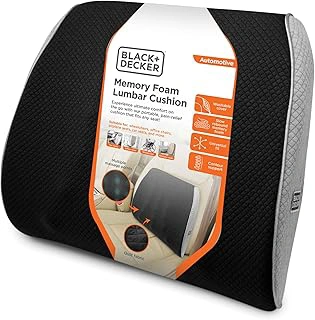
BLACK+DECKER Memory Foam Lumbar Support Pillow
At $14.99, the BLACK+DECKER Memory Foam Lumbar Support Pillow offers accessible lower-back support for anyone who needs a basic upgrade without stretching their workspace budget. The 4.2-out-of-5 rating reflects its position as an entry-level option: you gain simple cushioning and a straightforward elastic strap attachment, but materials and construction stay streamlined to hit the price point.
The memory foam is thinner than premium alternatives, so expect moderate rather than deep contouring. If you lean back firmly or sit for eight-plus hours, the compression may feel less resilient by mid-afternoon. The cover fabric prioritizes cost over breathability, which can matter in warmer offices or if you run warm while seated.
Strap design is uncomplicated - one or two elastic loops that hook around your chair back. Installation takes seconds, and the system works on most standard office chairs, but adjustment range is narrower than ratchet or dual-hook designs. If your chair has an unusually wide or curved backrest, check that the straps will reach and hold tension.
This model makes sense when budget is the deciding factor, when you want to test lumbar support before committing to a higher-tier pillow, or when you need a spare for a second workspace. Set expectations around firmness and durability in line with the price, and the BLACK+DECKER becomes a practical first step toward better seated posture.
- ✅ $14.99 entry price makes lumbar support accessible
- ✅ Simple elastic strap installs in seconds on most chairs
- ✅ Memory foam provides basic contouring for shorter sessions
- ⚠️ Thinner foam compresses faster during long sitting periods
- ⚠️ Cover fabric offers less breathability than premium options
- ⚠️ Limited strap adjustment range on wider or curved chair backs
How We Chose the Best Lumbar Support Pillows
Choosing lumbar support pillows for office chairs requires focus on how attachment systems work with your chair's backrest, whether the foam maintains its shape across long work sessions, and how the pillow handles heat buildup when you're seated for hours. We evaluated strap adjustment range to confirm each pillow could secure tightly to both narrow mesh backs and wider fabric chairs without slipping. Foam rebound time mattered because pillows that compress permanently lose support within weeks, so we looked for memory foam that returned to shape after pressure was removed. Heat retention became a factor during multi-hour use - some covers trap warmth against your lower back, while this product fabrics or mesh panels let air circulate. Thickness compatibility was critical since deep cushions push you too far forward on compact chairs, and thin ones disappear against tall, contoured backrests. We also weighed price against features like removable covers, dual-strap systems, and foam density to identify fair value without sacrificing durability.
We excluded any pillow that made therapeutic or medical claims we couldn't verify, products without adjustable attachment straps that would limit chair compatibility, and designs requiring permanent installation or modification to the chair frame. Each recommendation included here uses elastic or buckle straps that wrap around the backrest, fits standard office chairs without tools, and relies on mechanical support and comfort rather than unproven health promises.
How to Install and Adjust Your Lumbar Support Pillow
Position the pillow so its thickest part sits at your belt line, aligning with the natural inward curve of your lower back. Most people make the mistake of placing lumbar support too high - closer to the shoulder blades - which pushes the mid-back forward and leaves the actual lumbar region unsupported.
Thread the attachment straps around the chair back and fasten them snugly, but not tight enough to compress the foam or restrict your ability to shift position. Pull the straps until the pillow stays in place when you press against it, then sit down and lean back fully to confirm it doesn't slide up or tilt to one side.
If you're taller than average, move the pillow up one or two inches from the belt line; shorter users often need it slightly lower. For chairs with a pronounced recline or waterfall seat edge, angle the bottom of the pillow forward so the curve matches your spine when you settle into the backrest.
Check stability after fifteen minutes of sitting. Straps that feel secure while standing can loosen once body weight compresses the foam. If the pillow migrates upward during use, tighten the top strap and loosen the bottom slightly to anchor the base. Avoid cranking the straps so hard that they create a gap between the chair back and the pillow's edges, which reduces contact area and turns firm support into a pressure point.
Test different placements over a few days rather than committing to the first setup. Small adjustments - half an inch up or a notch tighter on one strap - can shift the pillow from tolerable to genuinely comfortable once your posture adapts to the added support.
Lumbar Pillow vs. Ergonomic Chair: Which Upgrade Makes Sense?
A lumbar pillow can transform an uncomfortable office chair for $15 - $40, while a quality ergonomic chair typically starts around $250 and can exceed $1,000. The right choice depends on how much time you spend seated, whether you own the chair, and what specific discomfort you're trying to address.
Lumbar pillows work best when your chair has a functional seat pan and armrests but lacks lower back contouring. They add targeted support without replacing the entire seating system, making them ideal for rental offices, shared workspaces, or situations where you can't justify a multi-hundred-dollar investment. Most memory foam and mesh pillows adjust via elastic straps, so you can dial in the exact curve and height that matches your spine.
A full ergonomic chair makes sense when your current seat sags, the cushion is worn flat, or the frame no longer holds your weight securely. Chairs with integrated lumbar mechanisms, seat-depth adjustment, and synchronized tilt offer a wider range of fit than any add-on pillow. If you work eight or more hours daily at a dedicated desk you control, the upfront cost spreads across years of use.
Consider chair condition first: if the seat pan is intact and the base is stable, a lumbar pillow will likely deliver the support you need. If multiple components are failing or you're constantly shifting to find a tolerable position, the chair itself is the limitation. Budget and workspace permanence close the decision - temporary setups favor pillows, long-term dedicated stations favor purpose-built seating.
Frequently Asked Questions
Frequently Asked Questions
Choosing a lumbar support pillow often raises practical questions about fit, durability, and compatibility with different chair types. Here are answers to the most common concerns.
How thick should a lumbar pillow be?
Most lumbar support pillows range from 3 to 5 inches in thickness. A 3-inch pillow works well if you sit close to your backrest or prefer subtle support, while 4 to 5 inches provides more pronounced forward positioning for deeper chairs or when you need stronger lower-back contact. The right thickness depends on your chair depth and how far you naturally sit from the backrest.
Can you use a lumbar pillow with a mesh chair?
Yes, lumbar pillows work with mesh chairs as long as the strap system allows secure attachment. Adjustable elastic straps that loop around the backrest frame or vertical supports are the most reliable option. Avoid pillows that rely on friction alone, since mesh fabric offers less grip than upholstered surfaces.
How long does memory foam last with daily use?
Standard memory foam lumbar pillows typically maintain their shape for one to two years with regular office use. High-density foam versions may last longer, while lower-density foam can begin to compress or lose rebound within six to twelve months. Rotating the pillow occasionally and using a this product cover can extend its usable life.
Do straps damage chair fabric?
Adjustable elastic straps are generally safe for most office chair fabrics when installed correctly. Over-tightening can create pressure marks on softer upholstery, and rough buckles may snag delicate materials. Positioning straps over the chair frame rather than directly against fabric reduces wear. Chairs with leather or vinyl finishes handle strap tension better than loosely woven textiles.
Will a lumbar pillow fit a gaming chair?
Many lumbar pillows designed for office chairs also fit gaming chairs, provided the backrest height and strap reach accommodate the seat. Gaming chairs with built-in lumbar cushions may create layering issues, so check whether the existing support is removable. Strap-based designs with at least 24 inches of reach and adjustable vertical positioning offer the best compatibility across chair styles.
What to Look for in a Lumbar Support Pillow
- Adjustable strap system that fits your chair width and back height without slipping
- Memory foam density that rebounds slowly and holds shape after hours of use
- Cover material that resists heat buildup during long work sessions
- Thickness between 3 and 5 inches to fill the lumbar gap without pushing you forward
- Attachment method compatible with mesh, fabric, or leather chair backs
- Neutral or contoured shape that matches your natural lumbar curve