We may earn a commission when you buy through links on this page, at no extra cost to you. How this works.
Heavy monitors demand more than standard gas spring arms can deliver. A 27-inch display weighing 15 pounds might work on any mount, but once you move into 32-inch or ultrawide territory - where individual panels can reach 20 pounds or more - many dual-monitor arms sag, drift, or lose tension within weeks.
Weight capacity per arm is the first filter. Look for mounts rated at least 9 kg (roughly 20 lbs) per arm if you're running large screens. Gas spring quality determines whether the arm holds position under load or slowly creeps downward during the workday. Cheaper springs use thinner steel coils and lighter hydraulic fluid, which compress unevenly when supporting maximum weight. Better designs use reinforced cylinders with adjustable tension screws, letting you fine-tune resistance as monitor weight changes.
VESA 75 and 100 compatibility covers most monitors, but verify your exact mounting hole spacing before buying. Desk clamp thickness tolerance matters for sit-stand desks and thick hardwood tops; many arms max out at 3 inches, forcing you into grommet-mount installations you may not want. Cable routing clips or channels keep power and video cables tidy, especially when you're articulating two heavy screens that otherwise tangle every adjustment.
This guide excludes single-arm mounts and fixed (non-spring) brackets. Every option here uses gas springs and supports two monitors. The tradeoff you'll face: wider articulation range often means less rigidity, because longer arms and more pivot points introduce flex under heavy loads. If you rarely reposition your screens, a shorter-arm design with fewer joints will stay stable longer than a fully articulating model that lets you swing monitors in every direction.
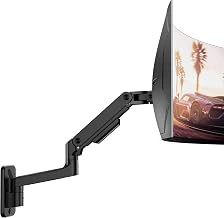
ARES WING Heavy Duty Single Wall Monitor Arm for 17-49 Inch Ultrawide Screens, Black
If your desk has no clamp space or you prefer a permanent wall solution, the ARES WING Heavy Duty Single Wall Monitor Arm offers an alternative mounting approach for large ultrawide screens between 17 and a larger amount. This is a wall-mounted unit, not a desk arm, so it requires access to wall studs and drilling.
The arm accommodates ultrawide monitors in that broad diagonal range, which covers most common large-format displays. Wall mounting keeps the desk surface completely clear and works well in setups where the desk position might change but the screen location should stay fixed. You will need to locate studs, mark holes accurately, and commit to the position before installation.
VESA compatibility details are not specified in the verified product information, so confirm your monitor's VESA pattern matches before purchasing. The black finish blends into most office walls without standing out.
Articulation range is not detailed in the available specs, so expect basic tilt and swivel rather than the full multi-joint movement desk-mounted gas spring arms provide. Weight capacity is not listed, which means you should verify your monitor's weight and check the manufacturer's current specifications directly to avoid overloading the mount.
At $69.99, this arm costs less than many dual-monitor desk mounts, but it serves a single screen and requires wall installation. It fits users who have wall access, want a clean desk, and do not need frequent repositioning. If you cannot drill into your wall or need to move your monitor often throughout the day, a desk-mounted gas spring arm will offer more flexibility.
- ✅ Wall-mounted design frees up entire desk surface
- ✅ Supports ultrawide screens from 17 to 49 inches
- ✅ Lower price point than many dual desk mounts
- ⚠️ Requires wall stud access and drilling
- ⚠️ Single monitor only, not dual
- ⚠️ Weight capacity and VESA compatibility not specified in verified details
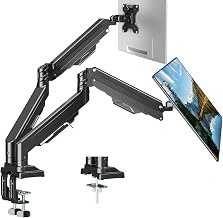
Heavy Duty Dual Monitor Mount for Screens up to 43", Ultrawide Desk Mount
This mount handles screens up to a larger amount per arm, making it one of the few desk-mount options that work with ultrawide or larger displays. Each arm supports monitors with standard VESA patterns, and the gas spring mechanism adjusts to hold the weight once you set the initial tension. The clamp fits desk edges between multiple and a larger amount thick, and the C-clamp design spreads the load across a wider surface than single-post mounts.
Gas spring tension adjusts with an Allen key. Tighten it for heavier monitors, loosen it for lighter ones. Once balanced, the arms stay where you position them without drifting. The mount includes cable clips along each arm to route power and video cables cleanly. Desk installation takes about twenty minutes with basic tools.
A wall-mount alternative saves desk space and keeps the surface clear, but requires drilling into studs and limits your ability to reposition monitors quickly. This desk mount trades a larger footprint for flexibility - you can move it between desks, adjust height and angle throughout the day, and skip wall damage. For renters or anyone who rearranges workspaces often, the desk clamp setup makes more sense. For permanent setups where desk real estate matters, a wall mount stays out of the way.
The arms extend far enough to position each screen independently. You can angle them for side-by-side viewing, stack them vertically, or pull one forward for close work. The range of motion works well for corner desks or L-shaped configurations where monitors need to pivot more than straight setups.
At $79.99, this mount costs less than separate single-monitor gas spring arms while handling larger screens. The weight capacity and adjustability make it suitable for heavy desk setups with multiple-inch or ultrawide displays.
- ✅ Supports screens up to 43 inches per arm
- ✅ Gas spring tension adjusts with Allen key for different monitor weights
- ✅ Desk clamp fits edges 0.4 to 3.9 inches thick
- ✅ Cable management clips included along arms
- ✅ Independent arm positioning for flexible configurations
- ⚠️ Desk clamp takes up more surface space than wall-mount alternatives
- ⚠️ Requires manual tension adjustment during initial setup
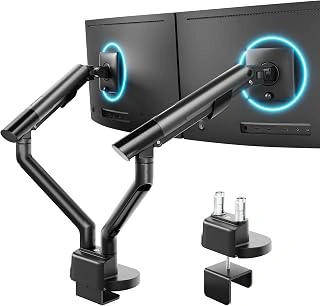
monTEK Aluminum Dual Monitor Arm for 17-35" Screens, Black, Full Motion VESA
The monTEK Aluminum Dual Monitor Arm offers full-motion articulation for screens between 17 and a larger amount, targeting users who need frequent repositioning and organized cables. The aluminum construction keeps weight down while providing enough rigidity for most mid-size displays, and the integrated cable routing channels help maintain a clean workspace when multiple cables run to each screen.
Full-motion VESA mounts give you tilt, swivel, and rotation on both arms, which works well for shared desks or workstations where you switch between landscape and portrait orientations. The routing channels guide DisplayPort, HDMI, and power cables along each arm, reducing the tangle that usually accumulates behind dual monitors. This design suits users who value adjustment range and cable tidiness over supporting the largest or heaviest screens on the market.
At $80.99, this arm fits budgets that can't stretch to premium steel models but still want aluminum over plastic. The a larger amount range covers most standard office monitors and many gaming displays, though you'll need to verify your screens fall within the specified weight limits before mounting. The black finish blends into most desk setups without drawing attention.
If you frequently adjust monitor height and angle throughout the day and prefer cables routed out of sight, the monTEK delivers practical value without the bulk or cost of heavier-duty alternatives.
- ✅ Full-motion articulation for tilt, swivel, and rotation
- ✅ Integrated cable routing channels reduce desk clutter
- ✅ Aluminum construction balances weight and rigidity
- ✅ Fits 17-35 inch screens for most office and gaming monitors
- ⚠️ Weight limits may exclude the largest or heaviest displays
- ⚠️ Aluminum may flex slightly under maximum rated load
How to Install and Adjust Gas Spring Tension Safely
Desk clamp installation requires a flat, accessible edge at least 0.4 inches thick and no more than 4 inches deep. Position the clamp near a desk corner or cable management zone, ensuring the arm's rotation path won't collide with walls or shelves. Thread the clamp screw through the mounting post, slide the protective pad against the desk underside, and hand-tighten before using the included hex key to secure firmly without overtightening, which can crack laminate surfaces.
Attach the VESA plate to each monitor before mounting. Align the plate's 75×75 mm or 100×100 mm holes with the monitor's rear threads, then fasten with the supplied M4 screws, checking that the plate sits flush and level. Tilt the monitor forward slightly to confirm the plate doesn't obstruct ports or power buttons.
Mount the heavier monitor first to establish baseline tension. Slide the VESA plate onto the arm's quick-release bracket until the locking pin clicks, then gently release your grip to observe whether the monitor holds position or drifts downward. If drift occurs, locate the hex socket on the arm's joint - usually a 4 mm or 5 mm Allen fitting near the pivot - and turn clockwise in quarter-turn increments, testing stability after each adjustment. Repeat for the second monitor, matching tension so both screens settle at the same height without sagging.
Test the full range of motion by raising each monitor to maximum height, extending the arm fully, and rotating through tilt and swivel angles. Watch for slow creep over 30 seconds; any gradual drop signals insufficient spring tension. If a monitor snaps upward when released, reduce tension counterclockwise in small steps until movement feels controlled and the screen pauses smoothly at any height.
Route cables last to prevent interference with arm movement. Use the integrated cable clips or channels along the arm's length, leaving slight slack at each pivot point so cables don't pull taut during extension or rotation. Zip-tie bundles loosely rather than cinching tight, and keep power bricks on the desk surface or a tray rather than hanging from the arm to avoid unbalanced weight.
Wall Mount vs. Desk Clamp: Which Fits Your Setup?
Choosing between a wall-mounted arm and a desk clamp comes down to desk access, wall structure, and flexibility. Wall mounts free up desk space entirely and eliminate weight stress on your work surface, but they require locating studs, drilling pilot holes, and permanent installation. Desk clamps attach to the edge or pass through a grommet hole, requiring no wall damage and allowing you to reposition or remove the arm when you move furniture or upgrade monitors.
Wall-mount arms work best when you have direct access to studs behind drywall and own your space. They handle heavy dual monitors without concern for desk thickness or edge stability. However, renters, users with adjustable-height desks, or setups where wall studs don't align with your monitor position will find desk clamps more practical. Clamp mechanisms spread load across the desk edge, so verify your desktop is at least one inch thick and made from solid wood or steel-reinforced material before mounting heavy screens.
The ARES WING wall-mount option supports two monitors and mounts directly to studs, while dual desk-mount arms like those in this guide attach via C-clamp or grommet base. If your wall is inaccessible or you prefer to avoid drilling, a grommet mount distributes weight through the desk surface rather than clamping the edge. Evaluate your desk material, wall proximity, and whether you need to reposition the arm in the future before committing to one mounting style.
Final Verdict: Match Your Arm to Your Monitor Size and Desk Type
Choosing the right dual-monitor arm depends on your screen weight, VESA pattern, and whether you prefer desk-mounting or wall-mounting. The ARES WING works best for wall-mounted configurations with ultrawide or heavy gaming monitors, thanks to its 22 lb per-arm capacity and ability to free up desk real estate entirely. The Heavy Duty Dual Mount handles the largest screens - up to 27 inches and higher total loads - making it the safer choice when you're pushing weight limits on a desk-mounted setup. The monTEK offers the smoothest articulation and cleanest cable routing, ideal when you adjust monitor positions frequently and want a tidy workspace.
Before ordering, measure your monitors' VESA hole spacing (75×75 mm or 100×100 mm are standard) and weigh each screen to confirm it falls within the arm's per-monitor limit. Gas springs lose tension over time if overloaded, so leaving a pound or two of headroom prevents sagging. Check your desk thickness if mounting with a clamp, and confirm wall studs are accessible if going the wall-mount route. A tape measure and your monitor's spec sheet will save you from returns and compatibility headaches.
Match the arm to your actual use case rather than over-speccing. If your monitors rarely move, prioritize load capacity and stability. If you switch between sitting, standing, or sharing your screen during video calls, articulation and smooth adjustment matter more. Either way, verify the weight and VESA fit first - those two variables determine whether an arm works or fails in a heavy setup.
Key Specs to Verify Before You Buy
- Weight capacity per arm matches your monitor specs (include stand weight if unknown)
- VESA pattern is 75x75mm or 100x100mm and matches your monitors
- Desk clamp opens wide enough for your desk thickness (measure before ordering)
- Gas spring is adjustable and rated for the combined weight of both monitors
- Cable management routing works for your power and video cable count
- Articulation range allows the tilt, swivel, and height you need